
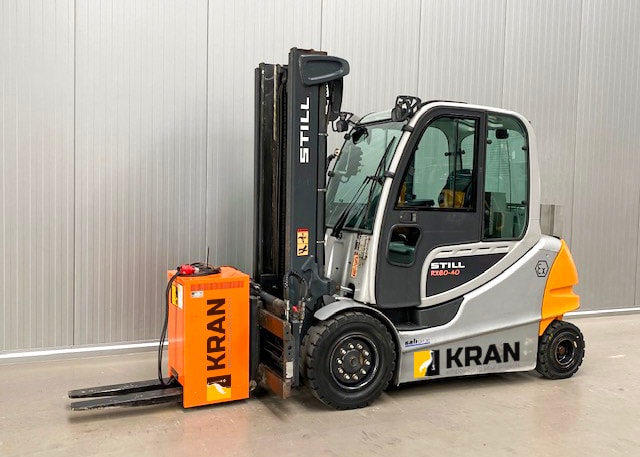
With forklifts, the right choice doesn't start with tonnage alone. What matters is whether you work indoors or outdoors, how narrow your aisles are, what lift height you need, how quickly the machine has to be refuelled, and whether there are special safety requirements.
This guide brings together the most commonly used forklift types: power sources, specialised machines, attachments and the special case of explosion-proof forklifts. The goal is to help you choose the right equipment in practical terms, without getting lost in technical detail.
For most local projects, the choice comes down to three questions: what load you're lifting, in what environment you're working, and how much flexibility you need from the machine during the operation.
The right choice
What to check before requesting a forklift
Real capacity
It's not just the rated tonnage that matters, but also the load's centre of gravity, its dimensions and the type of forks or attachment used.
Lift height
The difference between working at ground level, mid-height racking and high-bay storage immediately changes the type of mast and the recommended machine.
Indoor or outdoor
If you work in a hall, emissions, noise and turning radius matter. If you work outdoors, traction, ground clearance and range matter.
Working surface
Concrete, paving, uneven ground, sand or mud quickly rule out certain models and favour rough terrain machines or telehandlers.
Pace of operation
In long shifts and continuous operations, fast refuelling can matter more than the theoretical cost per hour.
Required attachments
If you need a side-shifter, fork positioner, rotator or crane jib, the machine has to be chosen together with the attachment.
By power source
Electric, diesel or LPG
In practice, this is the first filter: where you work, how heavy you lift and how quickly you need to be back at work after refuelling or charging.
Electric forklifts
They are best suited to halls, warehouses and areas where clean air, low noise and fine manoeuvrability matter.
- Zero emissions during operation and a lower noise level.
- Very good for indoor use and warehouse aisles.
- They make sense when battery charging fits the pace of the operation.
Diesel forklifts
They are preferred for heavy work, outdoor use, high tonnage and operations where durability and constant power are the priority.
- Suited to rough terrain and heavy loads.
- Stand up well on construction sites, in ports and industrial yards.
- Not the right solution for enclosed spaces without special conditions.
LPG forklifts
They are a middle option for mixed operations, where you want fast refuelling and flexibility between indoors and outdoors.
- Fast refuelling compared with battery charging.
- Mixed use, with adequate ventilation.
- A good compromise between range, cost and versatility.
Specialised types
Machines for different applications
Rough terrain
They have large tyres, suitable traction and a build designed for construction sites, farms and uneven surfaces.
Best for
Outdoor work, construction sites, industrial yards, events and areas without perfectly level flooring.
Watch out for
They are not the first choice for narrow warehouses or fine indoor operations.
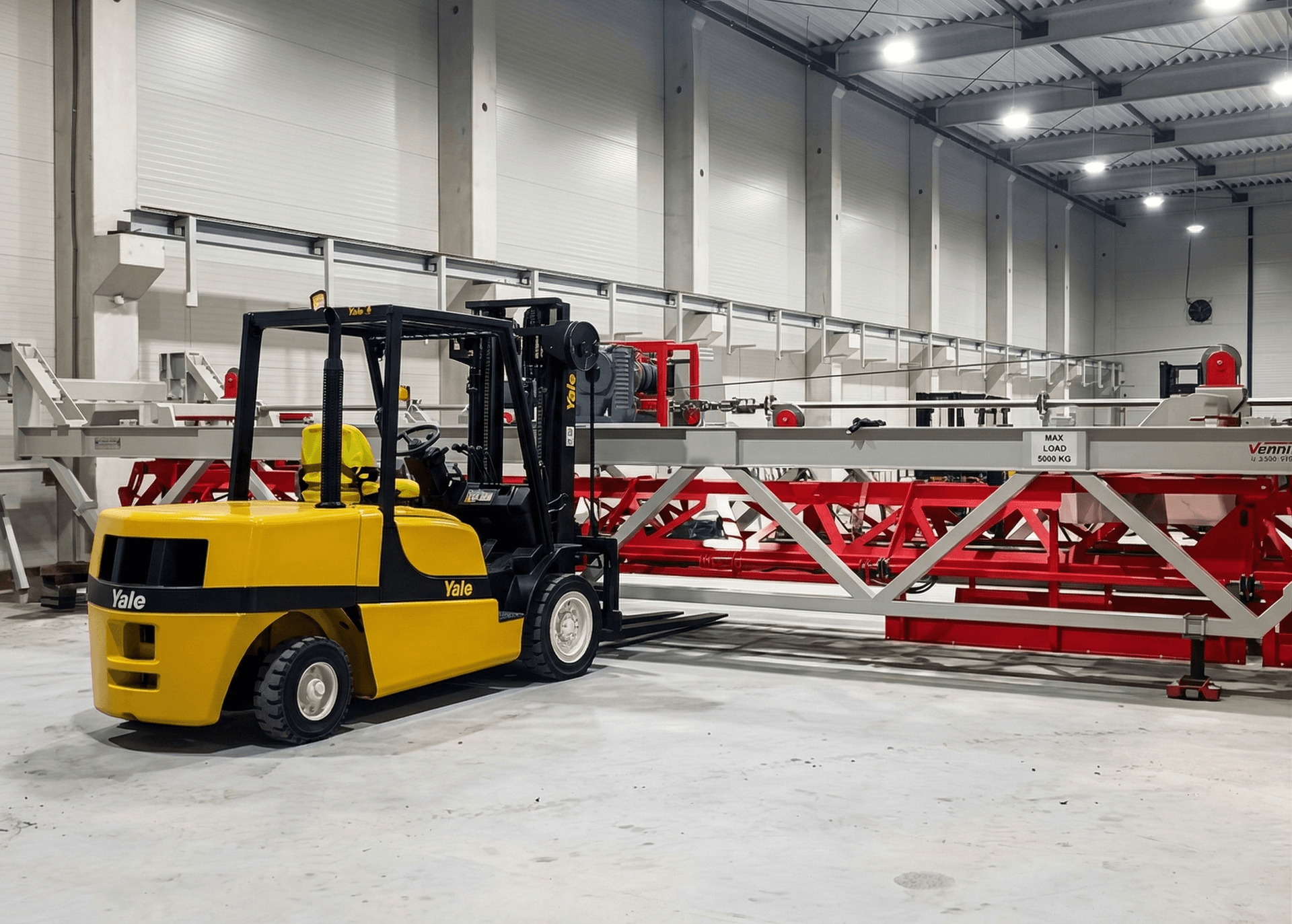
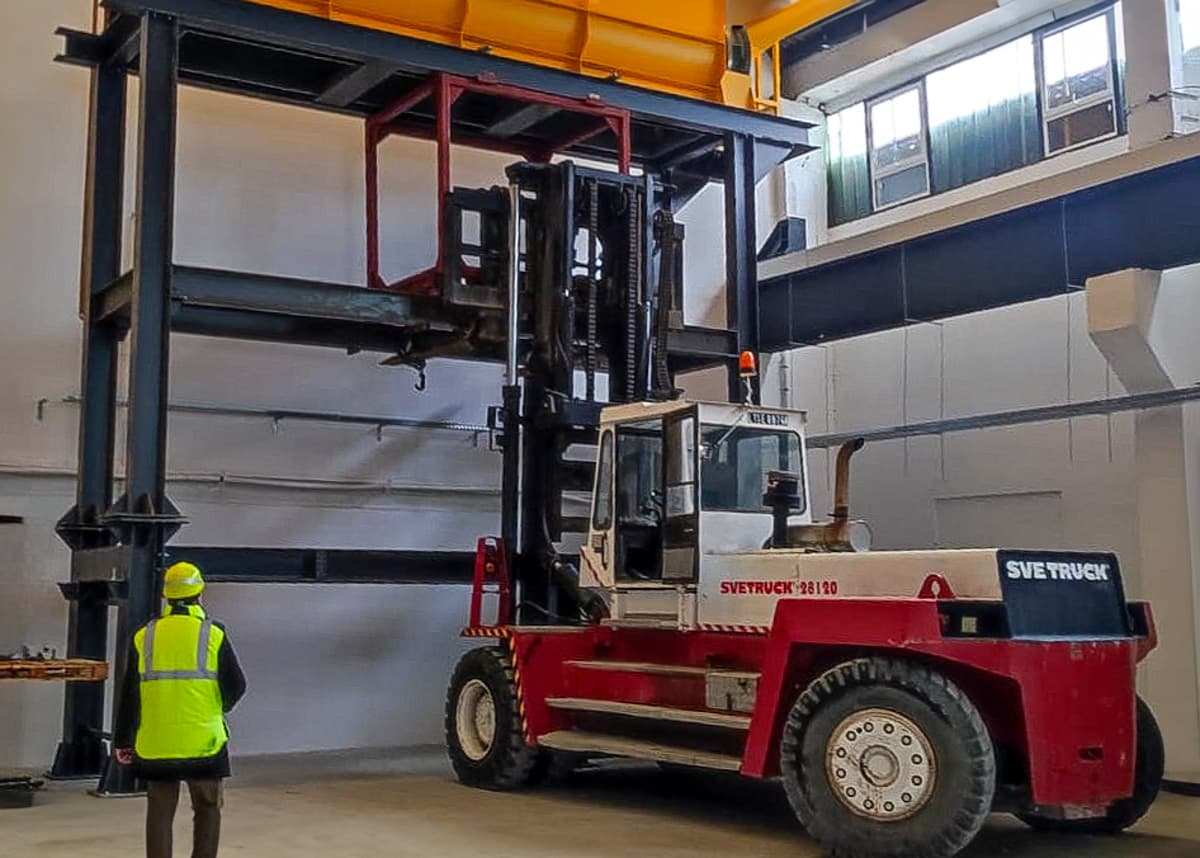
Heavy-duty industrial / high tonnage
These are the forklifts chosen when the load clearly exceeds the range of standard machines and you move into handling beams, containers and bulky cargo.
Best for
Ports, metallurgy, precast elements, beams and high-tonnage applications.
Watch out for
They demand space, planning and a serious check of the route and the surface.
Pallet trucks and pallet handling equipment
They are the simplest and most efficient way to move pallets quickly over short distances in compact spaces.
Best for
Retail, small warehouses, internal replenishment and ground-level handling.
Watch out for
They don't replace a classic forklift when you need real lifting at height.
Reach trucks and narrow-aisle machines
They are built for dense storage and work on high racking, where every centimetre of aisle counts.
Best for
Warehouses with high racking, narrow aisles and repetitive picking or storage flows.
Watch out for
They are not designed for outdoor terrain or uneven surfaces.
Telehandlers
They combine the logic of a forklift with the extendable boom of a construction machine, which makes them very useful at height or over obstacles.
Best for
Construction, agriculture, assembly and positioning over fences, scaffolding or structures.
Watch out for
Not every pallet-handling job needs a telehandler; sometimes a standard forklift is more efficient.
From field experience
The machine type isn't everything
Beyond the type of forklift, three things make the difference in practice: the difference between working environments, the importance of the mast and the role of attachments.
Simplex mast
For moderate heights and spaces where the machine has to stay compact.
Duplex
Offers more lift height without needlessly complicating the machine.
Triplex
Common in high-bay warehouses, where you need good access to racking and high lift.
Quadplex
Comes into specialised scenarios, with very high storage and stricter technical requirements.
Attachments
What can completely change the machine
Side-shifter
Moves the forks sideways for fine positioning without repositioning the whole machine.
Fork positioner
Quickly adjusts the fork width when you work with loads of different sizes.
Rotator
Useful when you need to empty containers, skips or bins in food processing and waste handling.
Specialised clamps
For paper rolls, cartons, drums or loads that don't suit classic forks.
Crane arm / jib
Turns the forklift into a spot-lifting solution for bulky or awkward parts.
Special case
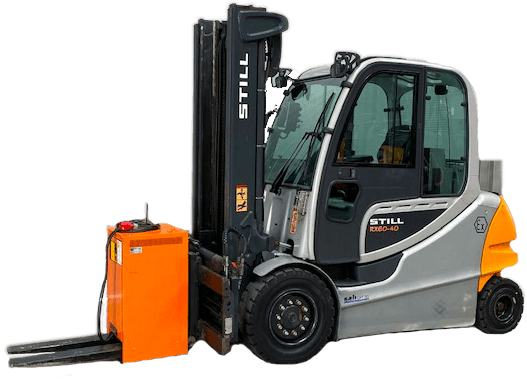
When you need an EX forklift
In an environment with gases, vapours or combustible dust, you don't improvise and you don't use a standard machine. You need an explosion-proof / EX-rated forklift, designed precisely so it doesn't become an ignition source.
Signs you need EX
- There are vapours, gases or combustible dust in the work area.
- Internal regulations or the ATEX zone rule out the use of a standard forklift.
- You need protected electrical components, temperature control and non-sparking materials.
What an EX machine has that's different
- Sealed and protected electrical components.
- Materials and coatings that reduce the risk of sparks.
- Temperature monitoring and control of ignition sources.
- Tyres and surfaces treated to reduce electrostatic discharge.
Practical use
What to choose depending on the project
Situation
Warehouse with racking and narrow aisles
Practical recommendation
You usually choose an electric model, a reach truck or a compact pallet solution, depending on the racking height.
Situation
Construction site and outdoor work
Practical recommendation
A rough terrain machine or a telehandler makes more sense than a classic warehouse forklift.
Situation
Port, metal or heavy cargo
Practical recommendation
This is where heavy-tonnage industrial forklifts and dedicated container handlers come into play.
Situation
Environment with explosion risk
Practical recommendation
You don't force a standard machine. The right choice is an EX-rated forklift certified for that environment.
Have an operation and aren't sure which forklift you need?
Send the weight, dimensions, lift height and a few photos from the field. In most cases, the right choice narrows down very quickly.
There is no single forklift that's good for everything. There is a machine suited to the combination of load, height, space, terrain, work pace and safety conditions.
In practice, the details that help most are simple: the weight and dimensions of the load, the lift height, the type of surface, the aisle width and whether special attachments are needed.
If your project is in Constanța or the nearby areas, a few photos and a short description of the operation are usually enough for us to quickly narrow the choice down to the forklift that makes sense.
See the forklift service